Stop Trading Kicks and Start Talking: A Clinch Crash Course for Fighters Who Never Learned It

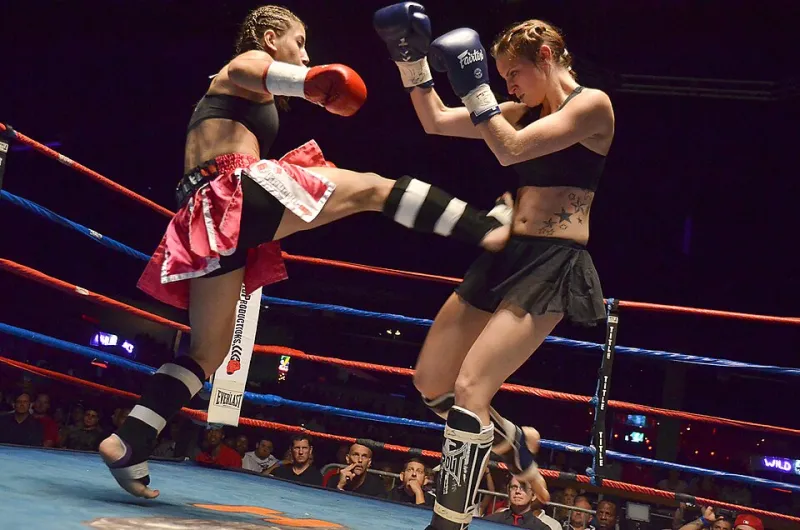
Photo: ThePortraitLady, CC0, via Wikimedia Commons
Watch any high-level fight in Thailand and you'll notice something American fighters often miss: the fight doesn't stop when the hands connect. It starts there. Two nak muay wrap up, jostle for position, land a knee, break, and reset — over and over, round after round. It looks boring to untrained eyes. It's actually a chess match happening at arm's length.
Now watch a typical amateur bout in the US. Two fighters touch gloves, exchange, clinch for two seconds, and the ref separates them before anyone's even established a grip. Nobody's winning the clinch because nobody's really fighting in it.
That gap matters more than most American fighters realize.
Why the Clinch Decides Rounds You Think You're Winning
Muay Thai scoring rewards control. When you lock up a double collar tie and your opponent is carrying your weight, backing up, and eating knees — the judges see dominance, even if nothing dramatic happens. Conversely, if you're the one getting steered around and dumped off balance, you're losing the round regardless of how clean your boxing looked in the pocket.
American fighters tend to fight in bursts: strike, reset, strike, reset. Thai fighters stay connected. The clinch is where they rest, think, and grind out points while their opponent burns energy. If you can't operate in that space, every clinch exchange becomes a coin flip — and coin flips compound over five rounds.
There's also the practical danger angle. Someone with real clinch experience will knee you in the liver and ribs repeatedly from positions you didn't even know were dangerous. Ask anyone who's sparred with a Thai veteran. Your ribs will remember.
The Three Positions You Actually Need
You don't need to master a hundred grips. You need three:
Inside control. Your forearms stacked inside your opponent's biceps, hands free to frame and strike. This is the neutral position — whoever wins inside control usually wins the exchange.
Double collar tie (the "Thai plum"). Hands laced behind the neck, elbows pinched together, pulling the head down to meet your knee. Everyone knows this exists. Few Americans can actually hold it against resistance.
Arm wrap and body lock. When someone beats your collar tie, you need somewhere to go. Wrapping an arm and locking the body lets you control a limb, kill their posture, and set up sweeps and trips.
Everything else is a variation of these. If you own these three, you can survive — and start winning — clinch exchanges.
Drills You Can Do Without a Clinch Class
Most US gyms don't run dedicated clinch sessions. Fine. Here's how to build the skill anyway:
Two-minute grip fighting rounds. Grab a partner after class. Start with both of you fighting for inside control only — no knees, no throws, just hands. Set a timer. When one person establishes inside control for a three-count, they win the rep and you reset. This is boring, tedious, and the single fastest way to develop hand-fighting comfort.
Neck strength work. The collar tie is miserable partly because your neck isn't strong enough to posture out. Add neck bridges and harness work to your routine three times a week. Ten minutes. Your future self thanks you.
Knee from the plum, on the bag. Heavy bag work isn't just for kicks. Lock your imaginary collar tie, pull the bag down, and drive knees into the body at 50% power for two-minute rounds. You're building the timing of pull-and-knee so it shows up automatically when you're tired.
Clinch-only sparring. Convince one training partner to do rounds where you start tied up and aren't allowed to break. Two minutes, light intensity, focus on position and off-balancing. Do this once a week and you'll feel the difference in a month.
Sweep practice off the body lock. Learn two basic trips — the inside leg sweep and the hip bump — and drill them slowly. You don't need highlight-reel throws. You need one dump you can hit when someone's leaning on you.
Study the Right Footage
For the Thai standard, watch Rodtang Jitmuangnon's early fights. His clinch work against fighters who tried to box him is a masterclass in controlling pace — he makes opponents carry his weight for entire rounds, then breaks to land the shot they're too tired to see.
On the American side, study Kevin Ross's later career. He understood that surviving the clinch — not winning it, just not losing it — let him keep fights at his preferred range. That's a realistic goal for your first few years.
The Bottom Line
The clinch isn't an advanced technique you'll get to someday. It's a third of the art, and if your gym never touches it, you're training two-thirds of Muay Thai and calling it the whole thing. Thirty minutes a week of grip fighting and knee work will put you ahead of 90% of amateur fighters in the US — most of whom are also skipping it.
Train the part everyone else ignores. That's how you steal rounds.