Cardio Kicks and Vanished Clinches: Five American Gym Habits That Wouldn't Survive a Week in Bangkok
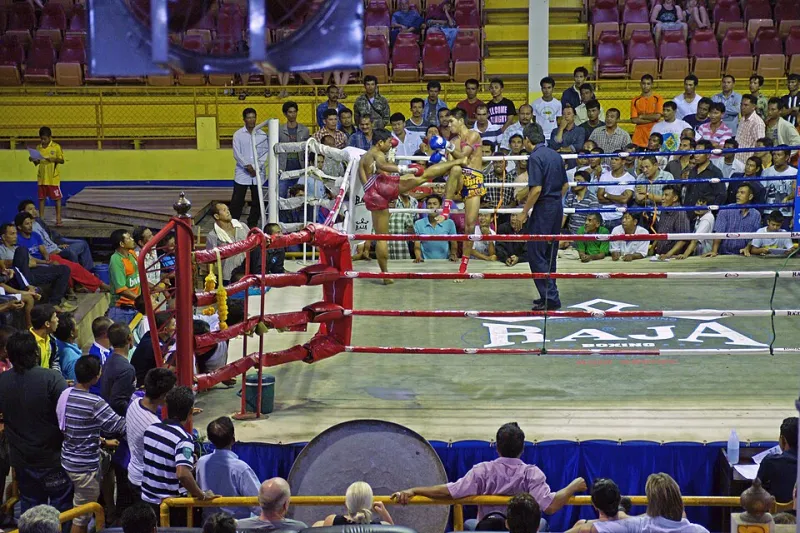
Photo: kallerna, CC BY-SA 3.0, via Wikimedia Commons
Spend enough years training in American Muay Thai gyms and you start collecting little doubts. Little moments where a coach says something, everyone nods, and a voice in the back of your head whispers, wait, really?
That voice is usually right. A lot of what passes for standard wisdom in US gyms exists for reasons that have nothing to do with fighting — liability, class structure, marketing, or just one instructor's lineage of mistakes getting passed down like a family recipe. Meanwhile, in the camps of Bangkok and the provinces, where kids fight monthly and the sport is woven into daily life, the same situations get handled completely differently.
Here are five of the biggest offenders. If any of these sound familiar, it might be time to ask your gym some uncomfortable questions.
1. "Don't clinch too much, you'll get tired"
This one drives me up a wall, because it's technically true and completely misses the point. Yes, clinching is exhausting. That's the training working.
In Thailand, the clinch isn't a specialty — it's the connective tissue of the entire art. Kids spend years neck-wrestling before they can throw a decent roundhouse. The knees that make Thai fighters famous live inside the clinch, and the ability to rest, control, and dump an opponent there is what separates a nak muay from a kickboxer with elbows.
American gyms quietly skip it for three reasons: it's hard to teach to thirty people at once, it looks aggressive to newcomers, and nobody wants an insurance claim from a beginner getting dumped on hardwood. So it becomes "advanced clinch class," offered once a week at 8 PM, which half the gym treats as optional.
Do instead: Treat clinch work as non-negotiable, not elective. Even ten minutes of light pummeling and position-switching after class builds the grip, balance, and comfort that pay off everywhere else in your game. If your gym never clinches, you're not training Muay Thai. You're training something adjacent.
2. "Hands high, chin down, elbows tight — that's your guard"
The long guard — arms extended, gloves leading, hands disrupting the opponent's vision — is treated like a stylistic flourish in the US, something skinny technicians do. Here, the textbook guard is a compact shell, borrowed more from Western boxing than anything else.
But watch any Thai fight, amateur or stadium-level, and the long guard is everywhere. It stuffs the clinch entries before they start, interrupts the opponent's line of sight so their timing goes soft, and gives you a frame to control distance without burning energy. It's not a style. It's a tool with a specific job.
The American version came over honestly — early US Muay Thai was heavily influenced by kickboxing and boxing coaches, and the compact shell works great for boxing-heavy exchanges. It just doesn't account for knees, clinch entries, or the tall, stalking rhythm of Thai style.
Do instead: Drill the long guard against the teep and the clinch entry specifically. Feel how much harder it is to grab someone whose arms are already in your way.
3. "Cardio kicks! Fifty each side, go!"
If your pad rounds involve sprinting through fifty kicks per side with zero regard for mechanics, balance, or what your pad holder is actually doing — congratulations, you're doing aerobics with shin guards.
In Thailand, pad work is a conversation. The trainer feeds specific reactions, moves around like an opponent, checks your kicks, sweeps your leg when you're off balance, and holds pads in positions that force correct technique. Rounds are fewer, but every rep has intent. A Thai trainer would sooner end the session than watch you flail at pads with your chin up and your hips disconnected.
The cardio-kick format exists because it's easy. It fills a class slot, everyone sweats, nobody needs individual attention, and it photographs well for the gym's Instagram. But you're rehearsing bad habits at speed, and speed is exactly how bad habits get welded in.
Do instead: Fewer kicks, full commitment. Reset your stance between reps. Ask your holder to check one of your kicks per round so you learn what a checked kick actually feels like.
4. "Sparring hard builds real fighters"
There's a strain of American gym culture — partly imported from boxing, partly from MMA machismo — that treats hard sparring as a virtue. You're either going hard or you're soft.
Thai camps, which produce arguably the most fight-tested athletes on earth, spar lighter than almost any American gym you'll walk into. Technical sparring, play sparring, touch sparring — the default is controlled, and the intensity is saved for the ring. Fighters in Thailand already fight constantly; beating each other up in training would mean showing up to the stadium already damaged.
The logic is simple: you can't sharpen a knife by smashing it against rocks. Hard sparring has a place, close to a fight, with proper protection and consent. As a weekly staple, it mostly produces injuries, burnout, and a gym full of guys who flinch.
Do instead: Ask what the sparring intensity policy actually is. If the answer is "we go hard every time," that tells you everything you need to know about how long the people there will last in the sport.
5. "You'll learn the culture stuff later — focus on fighting"
The Wai Kru, the Mongkhon, the music, the rituals — in a lot of American gyms, these get filed under "tradition," a nice-to-have you'll pick up someday, maybe, if you stick around.
In Thailand, the rituals aren't decoration. The Ram Muay is a warm-up, a focus ritual, and a demonstration of lineage all at once. The relationship between fighter, trainer, and camp — expressed through the Mongkhon and the ceremony — is the framework the whole training system hangs on. Strip it out and you're left with techniques floating in space.
American gyms skip this partly for time and partly because the fitness-market version of Muay Thai sells better without cultural homework. But students who understand why the art works the way it does — the respect for the clinch, the pacing, the rituals — train differently. They're more patient, more deliberate, and honestly, more fun to coach.
Do instead: Learn your gym's Wai Kru if it has one. If it doesn't, ask why. The answer will tell you a lot about what kind of place you're training in.
The Common Thread
Notice the pattern? Almost every one of these shortcuts exists to make Muay Thai easier to package — easier to teach in groups, easier to schedule, easier to market to Americans who want the workout without the depth.
None of this makes American gyms bad. Some of the best coaches in the world are working right here, adapting without gutting the art. But as an intermediate student, your job is to start noticing the seams. When something in class feels off — when the clinch keeps getting cut, when sparring feels like a bar fight, when pad work feels like a spin class — trust that instinct and go looking for the deeper version. The Thais built this art over centuries. The least we can do is not water it down on the way through customs.