The Garage Gym Illusion: What You Can Actually Build Alone (and What's a Beautiful Waste of Time)

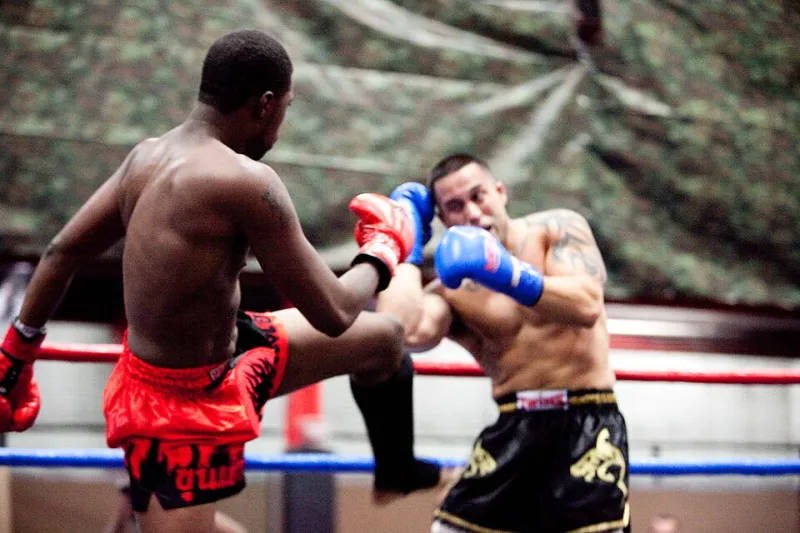
Photo: Edwin Macharia, CC BY-SA 4.0, via Wikimedia Commons
Let me save you some money and possibly your technique: you cannot learn Muay Thai at home. There. I said it. Now let me complicate it, because the full truth is more interesting than the hot take.
The rise of home training content has created a generation of practitioners who can shadowbox beautifully in their garage and fall apart the moment another human being is within arm's reach. But written off entirely, home training wastes a genuine resource. The question isn't whether to train at home—it's being honest about what home training is for.
What Actually Works in Your Living Room
Shadowboxing is the crown jewel. Done with intent, it's the single best skill-builder available to a solo practitioner. The catch: most people do it wrong. Wandering around throwing combos at the air with no opponent in mind is exercise, not training. Fix it by visualizing a specific opponent—taller, shorter, southpaw—and reacting to what they'd throw. Film yourself. Compare it to footage of actual fighters. Ten focused rounds of shadowboxing beats thirty distracted minutes, every time.
Heavy bag work builds attributes, not skills. Power, conditioning, and combo fluency—yes. Timing, distance management, and defense—no. The bag doesn't check your kicks or punish your lazy entries. Use it for what it's good at: hard rounds with real intent. Set a round timer. Throw combinations, not single shots. Finish every exchange, because the bag lets you develop the terrible habit of stopping after two strikes when a real opponent won't.
Footwork drills are criminally underrated. Ladder work, pivot drills, angle work off an imaginary attack—this stuff translates directly and requires zero equipment. Footwork is also the skill most gym-goers neglect, so home practice here actually gives you an edge.
Conditioning is fully solvable at home. Skip rope, do your roadwork, build your core. Nobody needs a gym to get fight-fit.
What Deludes You
Now the uncomfortable part. Some things home training actively damages:
- Defense. You cannot learn to slip, check, or absorb a strike from something that doesn't strike back. Solo "defense training" is choreography.
- The clinch. Muay Thai without clinch work isn't Muay Thai—it's kickboxing with elbow aspirations. There is no home substitute. None.
- Timing and distance. The entire chess match of fighting lives in the space between two people. A bag has no range.
- Feedback. Bad habits compound silently. Without a coach catching your dropped hands or your telegraphed kicks, you're rehearsing your flaws until they're permanent.
The worst home-training horror stories I've seen all follow the same arc: six months of solo bag work, huge confidence, first sparring session, total collapse. Confidence built without contact isn't confidence—it's a debt that sparring collects with interest.
Three Home Setups, Three Budgets
The $150 Start: A quality jump rope ($20), a free-standing or doorway pull-up bar for conditioning ($50), and a decent pair of gloves plus hand wraps for shadowboxing with resistance ($80). Skip the bag entirely at this level—a cheap bag you'll outgrow in a year is worse than saving up.
The $600 Workhorse: Everything above, plus a 100-pound heavy bag with a proper stand or ceiling mount ($300–400). If you've got the space and a willing landlord, this is the sweet spot. Add a cheap phone tripod for filming your rounds—easily the highest-ROI training tool on this list.
The $2,000 Serious Setup: The works—heavy bag, uppercut bag or double-end bag, quality gloves and shin guards, a round timer app subscription, stall mats for floor work, and ideally a BOB-style dummy for target-specific drilling. This is a genuine training corner, not a toy. But understand: even at this level, you're maintaining and supplementing gym skills, not replacing them.
The Verdict
Home training is a supplement, not a diet. Treat it as your homework between classes—shadowboxing with intent, conditioning, footwork—and it will make you noticeably better within months. Treat it as a substitute for coaching and contact, and you're not training Muay Thai. You're performing it, alone, for an audience of one person who doesn't know enough to critique you.
Get to a gym. Do your homework at home. That's the whole formula, and it's the only one that works.