Stop Leg-Pressing Your Opponent: Rebuilding Your Teep From the Ground Up
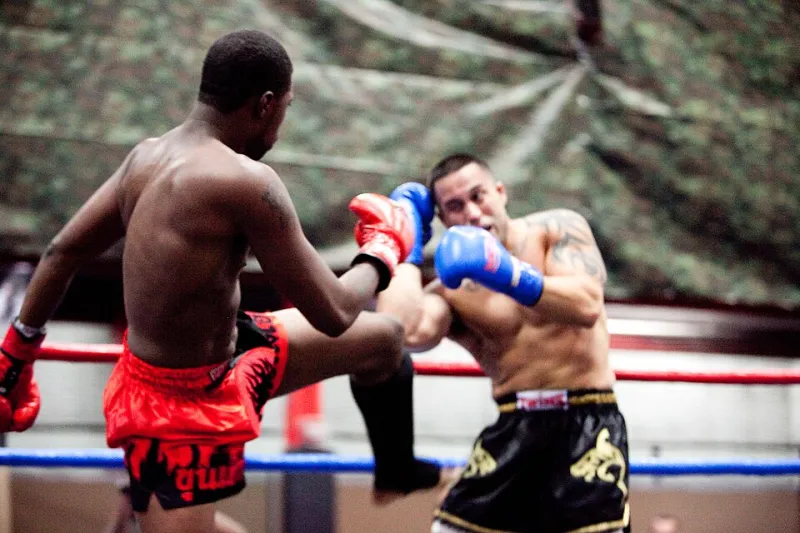
Photo: David Maiolo, CC BY-SA 3.0, via Wikimedia Commons
Watch ten rounds of beginner sparring at any American gym and count the teeps. You'll see plenty of them — and almost all of them will look wrong. The leg snaps out like a front kick on a treadmill, the fighter leans back, and the opponent gets shoved half a step away before walking right back in. It's a push. It's not a conversation.
In Thailand, the teep (teep trang when thrown with the lead leg) is arguably the most important weapon in the entire arsenal. Not the most spectacular — that's the head kick. Not the most feared — that's the elbow in close. The most important. And the gap between how Thais throw it and how most of us learn it comes down to one misunderstanding: we think it's about distance. It's actually about rhythm.
The Leg-Extension Problem
Here's how most American gyms teach it, whether they mean to or not: chamber the knee, extend the leg, hit with the ball of the foot, retract. That's it. It's basically a sidekick's cousin, and the result is a teep that does exactly one thing — creates space.
That's not a bad outcome. But it's one note on an instrument that's supposed to play the whole song. When your teep's only job is "push person backward," a few things go wrong:
- You telegraph it. A big chamber and full extension takes time, and anyone with a few months of experience reads it coming.
- You lose balance. Leaning back to extend your range puts your weight on your rear heel, which is exactly where you don't want to be when someone catches your leg.
- You waste the moment. Every teep is a chance to score, disrupt, or hurt. The push-teep only does one of those.
Three Teeps, Three Jobs
Start thinking of the teep as three different strikes that happen to share a shape.
The damaging teep. This is the one that ends exchanges. Rodtang Jitmuangnon has built a career on walking forward behind teeps that land with real stopping power — hips fully through, whole body weight behind the strike, hitting with the heel or the whole sole rather than a pointed toe. The difference from a push-teep isn't speed. It's commitment. Your hips travel forward into the kick instead of your leg traveling away from them.
The scoring teep. In a ruleset where judges reward clean, controlled strikes, a teep flush to the solar plexus or the midsection is a steady diet of points. Saenchai turned this into an art form — teeps thrown at odd angles, off balance, landing softly but unmistakably. Think of it like a jab that happens to be able to crack ribs.
The disruptive teep. This is the one most beginners never learn. It's not thrown to land hard; it's thrown to break timing. Opponent starts their entry? Teep the hip or thigh mid-step. Opponent settles into a rhythm? A teep to the belly resets their tempo and yours. Thai fighters use this teep constantly — it's why their opponents always seem to be fighting at an uncomfortable pace. You're not trying to knock anyone back. You're turning the metronome off.
Why We Got It Wrong
A lot of this traces back to how Muay Thai arrived in the US — filtered through kickboxing gyms, point-fighting backgrounds, and heavy bags bolted to garage walls. The push-teep works fine on a heavy bag, and a heavy bag doesn't walk forward afterward. Add in a general American sports bias toward power over control — we love highlight reels — and the subtle, rhythmic teep never stood a chance.
There's also a fear problem. Beginners don't trust the teep because a bad one gets your leg caught, and getting swept in sparring feels embarrassing. So they throw it safe: lean back, push, retreat. Safe teeps teach you nothing and score you less.
Rebuilding It Solo
If your teep is a leg press in disguise, here's a progression you can run with nothing but a wall and a chair.
1. The balance hold. Stand on one leg, knee chambered, foot extended at target height, and hold it for 10 seconds. No leaning. If you wobble, you've found your first problem — most people's teeps fail before the foot ever moves, because their supporting leg can't hold the hips upright. Three sets each side, every day.
2. The slow-motion extension. Chamber, then extend over a full three count. Feel the hip rotate forward slightly as the leg goes out. You should notice your weight staying over your standing foot, not drifting back. Do twenty slow reps per leg. This reprograms the "snap and lean" habit.
3. The step-through teep. Take a small step forward with your rear foot as you teep. This forces your hips to travel into the kick — the exact mechanic that separates a damaging teep from a push. Shadowbox with these mixed in, alternating between planted teeps and step-through teeps so you can feel the difference in your hips.
4. The rhythm drill. This is the one that changes everything. Set a metronome app to a moderate tempo and throw a disruptive teep on a random beat — not every count, just whenever. Then imagine an opponent's rhythm and practice stealing their beat: they step, you teep. You can even do this in front of a mirror shadowboxing, treating your reflection as the incoming pressure. The goal isn't power. It's timing.
5. Chair-height accuracy. Set a chair (or a couch arm, no judgment) at midsection height and teep it lightly, stopping on contact. This trains the ball-and-sole contact point without the ego of full power. Ten clean touches beats fifty sloppy launches.
Watch the Masters Do the Work
If you only do one piece of homework, pull up footage of Saenchai and Rodtang and just watch their feet — ignore everything above the waist for three rounds. Saenchai's teeps come from nowhere, at angles nobody expects, usually to break an entry rather than land a kill shot. Rodtang's come forward, heavy, daring you to try to walk through them. Same kick, completely different conversations.
That's the mental shift. Stop asking "how do I push this person away?" and start asking "what do I want them to do next?" A great teep makes your opponent hesitate, resets their rhythm, sets up your hands, and quietly stacks up points while doing it. The push-teep just buys you half a second that you'll spend backing up anyway.
The art of eight limbs starts with the foot that controls all of them. Fix the teep, and everything else in your game suddenly gets easier to throw.